Raga Behag
Saramaina 2.0
A contemporary presentation of Swati Tirunal's varnam, with Harsha Nagarajan, Akshay Anantapadmanabhan, Mahesh Raghvan, and IndianRaga.
“If I were not a physicist, I would probably be a musician. I often think in music.”
Albert Einstein
I share this belief: music is another way of structured creative thinking.
Carnatic music, the classical music tradition of South India, has evolved over centuries into a rich system of melody, rhythm, and improvisation. Its foundations lie in raga (melodic frameworks) and tala (rhythmic cycles). A raga is more than a scale: its characteristic phrases and subtle melodic ornamentations give it a distinct musical identity, while tala provides the structure for intricate rhythmic patterns and exploration. What fascinates me is how these precisely defined frameworks leave extraordinary room for individual expression and spontaneous creativity.
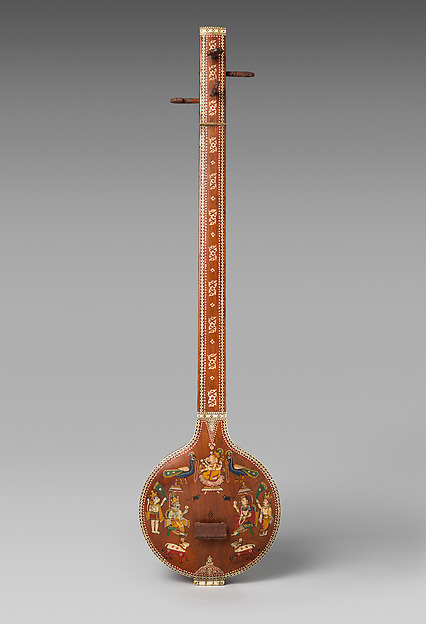
The intersection of classical Indian music and science has a rich history. Nobel laureate Sir C. V. Raman explored the acoustics of Indian musical instruments, including the tambura pictured on the right. In his 1921 research paper, On Some Indian Stringed Instruments, he investigated how the delicate interaction between the strings and the instrument's curved bridge produces its distinctive, richly resonant drone.
Alongside my career in science, I am a Carnatic vocalist, performer, and teacher. I was selected as an IndianRaga Fellow in 2013. My musical work spans concerts, collaborations, and original melodic settings of verses from classical Sanskrit texts. I have performed across India, including during Chennai's Margazhi music seasons, and the United States, and have presented lecture-demonstrations exploring the theory and structure of Indian classical music, including Raga for Starters: A Journey into Indian Classical Music at 3 Cups of Tea: Heritage from India in Santa Fe, New Mexico (presentation slides).
A selection of my performances, collaborations, and creative musical projects can be explored through the Spotify and YouTube links below.
Raga Behag
A contemporary presentation of Swati Tirunal's varnam, with Harsha Nagarajan, Akshay Anantapadmanabhan, Mahesh Raghvan, and IndianRaga.
Ragas Hamsadhwani and Pantuvarali
An IndianRaga Fellowship collaboration exploring memory, separation, and resolution through Carnatic and Hindustani musical ideas.
Music and nature
To me, music and nature are inseparable. Hiking in the Swiss Alps inspired this recording, shaped by the stillness and scale of the landscape.
I have been fortunate to mentor and train some of the most talented young classical musicians across several states in the United States. These projects reflect that shared process of learning, interpretation, and musical expression.

San Jose Raga Labs · 2017
Ten verses from Adi Shankaracharya's hymn, set by Harsha Nagarajan in ten ragas — Hamsadhwani, Hindolam, Devamanohari, Vasantha, Shanmukhapriya, Purna Chandrika, Abhogi, Arabhi, Desh, and Sindubhairavi.

IndianRaga Chicago Labs · 2015
Harsha Nagarajan's ragamalika setting in Kurinji, Kapi, Nagaswarali, and Hamsanandi, presented as a tribute to Smt. M. S. Subbulakshmi.

San Diego Raga Labs
A San Diego Raga Labs ensemble presentation of the devotional composition Baro Krishnayya.

San Jose Raga Labs
A San Jose Raga Labs ensemble presentation of Sharada Bhujangam.

Chicago Raga Labs
A Chicago Raga Labs presentation of the expansive Carnatic improvisational form Ragam Thanam Pallavi in raga Kanada.

San Jose Collaborative Labs
A collaborative San Jose Raga Labs interpretation centered on raga Charukeshi.

IndianRaga San Jose Labs
An ensemble presentation of Gopalakrishna Bharati's Tamil composition in raga Behag, an appeal to Nataraja for compassion.

IndianRaga Boston Labs
Harsha Nagarajan's arrangement unites Swagatham Krishna in raga Mohanam with the Meera bhajan Chalo Man Ganga Jamuna Teer in raga Bhupali.

Raga Labs · Intercity
Jayadeva's third Ashtapadi from the Gita Govinda, evoking spring in Brindavana and devotion to Krishna, set as a ragamalika by Harsha Nagarajan in Vasantha, Mohanam, Vakulabharanam, Brindavani, and Hamir Kalyani.
Alongside performing and teaching, I have been fortunate to have opportunities to build communities that make Indian classical music accessible to students and create lasting spaces for participation.
Founder · Carnatic Music Club · NIT Trichy
In 2006, with support from several faculty members, I founded Amruthavarshini at NIT Trichy, my alma mater, as a dedicated Carnatic music club to bring together enthusiasts across campus. Beginning with a Tyagaraja Aradhana, the initiative grew to include concerts and other campus programs that introduced students to Carnatic music and its traditions. This student-led club remains active today, two decades later.
Visit AmruthavarshiniStudent chapter president · Texas A&M University
From 2007 to 2013, I led the student chapter of the Society for the Promotion of Indian Classical Music And Culture Amongst Youth at Texas A&M University, also my alma mater. In that role, I organized concerts and lecture-demonstrations by leading classical musicians from India and created opportunities for students to engage directly with these traditions.
Read the Texas A&M interview